Observing the Night Sky

Before class preparation

  • Are there constellations during the day? What about during different seasons?
  • How can we tell a planet from a star in the night sky?
  • BYOD for Kahoots!
  • Videos:

In class activity

  • Finish “Using Constellations”
  • Finding Saturn in the constellation Leo
  • “Seasonal constellations”
    • Identify simple astronomical phenomena (revolution, rotation, gravitation..etc)
    • Identify the names different things we can see in the night sky (stars, planets, constellations, asterisms…etc)
  • Introduction to Scale of the Universe assignment
  • Kahoots!

After class work

  • For next class:
    • What is the largest object that you can think of?
    • What is the smallest object that you can think of?
  • Video: Retrograde motion of Mars

Constellations

Before class preparation

  • What are constellations?
  • How were constellations used throughout history?
  • What do modern astronomers use constellations for? Is there even a need?

In class activity

  • Activity: Using a Star Map, find constellations in the night sky
    • Name constellations & asterisms from a given pattern
  • Lesson: Using constellations
    • Identify the names different things we can see in the night sky (stars, planets, constellations, asterisms…etc)
    • Compare and contrast different astronomical terms
  • Finding the Big Dipper, Polaris, Sirius and other stars in the night sky

After class work

Lab: Reactivity Trends in the Periodic Table

Before class preparation

In class activity

  • Experiment: Trends in the periodic table

After class work

Quiz: Chemistry 1

Before Class Preparation

  • Complete all CK12 & Self Quizzes in Google Classroom
  • Bring a calculator

In Class Quiz

Can you

  • distinguish between physical and chemical properties?
  • distinguish between physical and chemical changes?
  • identify and name examples of physical properties?
  • use the density formula to find the volume, mass, or density?
  • explain the meaning and consequences of a substance being more or less dense than another?
  • identify WHMIS safety symbols?

Periodic Table Activity

Before class preparation

In class activity

  • Create your own table with Mystery Elements
    • Explain the relationship between the atomic structure of an element and the position of that element in the periodic table
  • Worksheets: Periodic Table 1Periodic Table 2

After class work

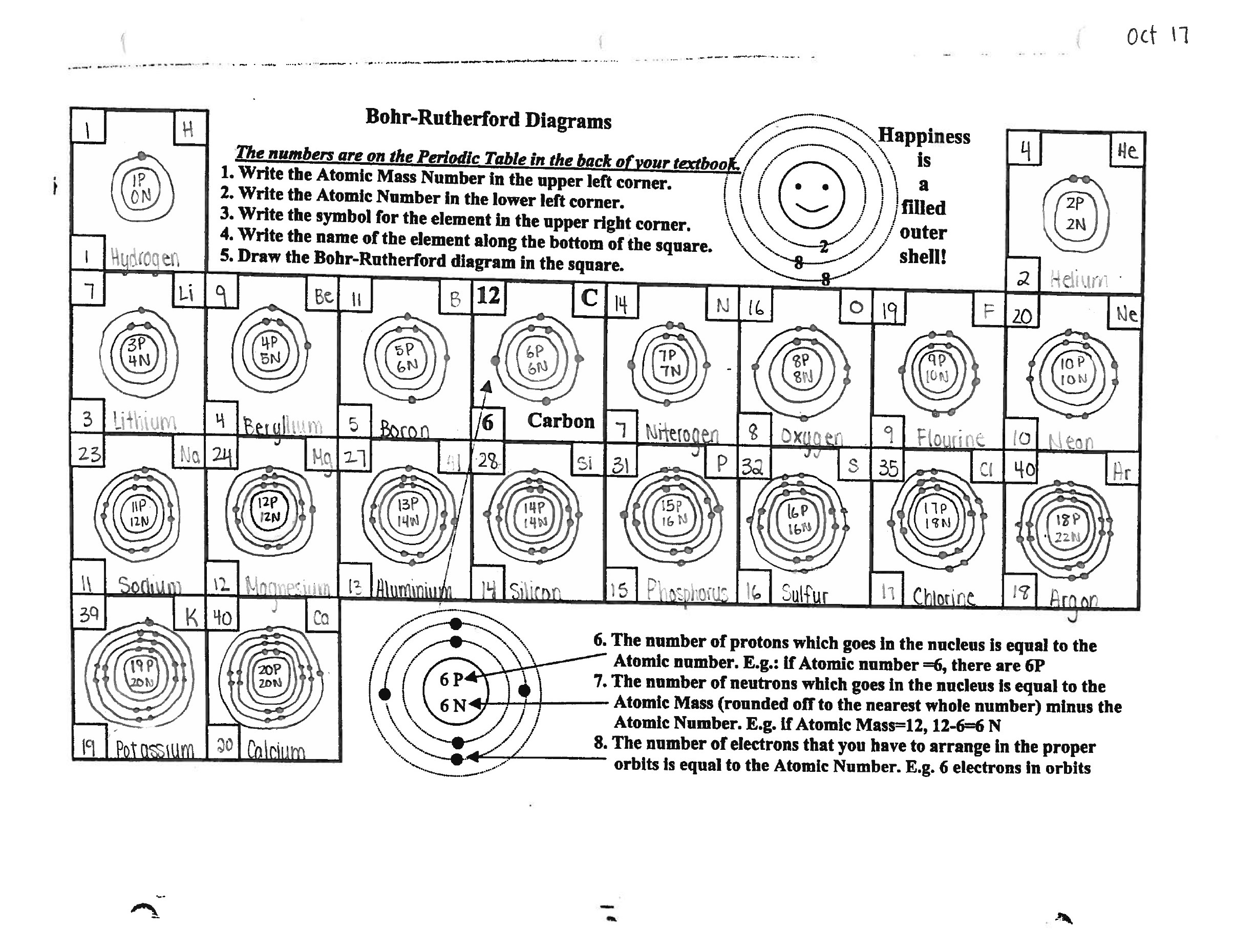
Game: Bohr-Rutherford Diagrams

Before class preparation

In class activity

  • If you haven’t finished the sheet in the preparation, you will be completing the sheet in class
  • Game: Bohr-Rutherford Diagrams
    • Describe patterns in the arrangements of electrons in the first 20 elements of the periodic table, using the Bohr-Rutherford model
  • Bohr-Rutherford Card Sort
  • Bohr-Rutherford Scavenger hunt

After class work

  • Check the answers for the BR-Diagram worksheet
  • Make sure you can draw a BR-Diagram for any of the 1st 20 elements with the aid of a periodic table only, you can be quizzed at any time!